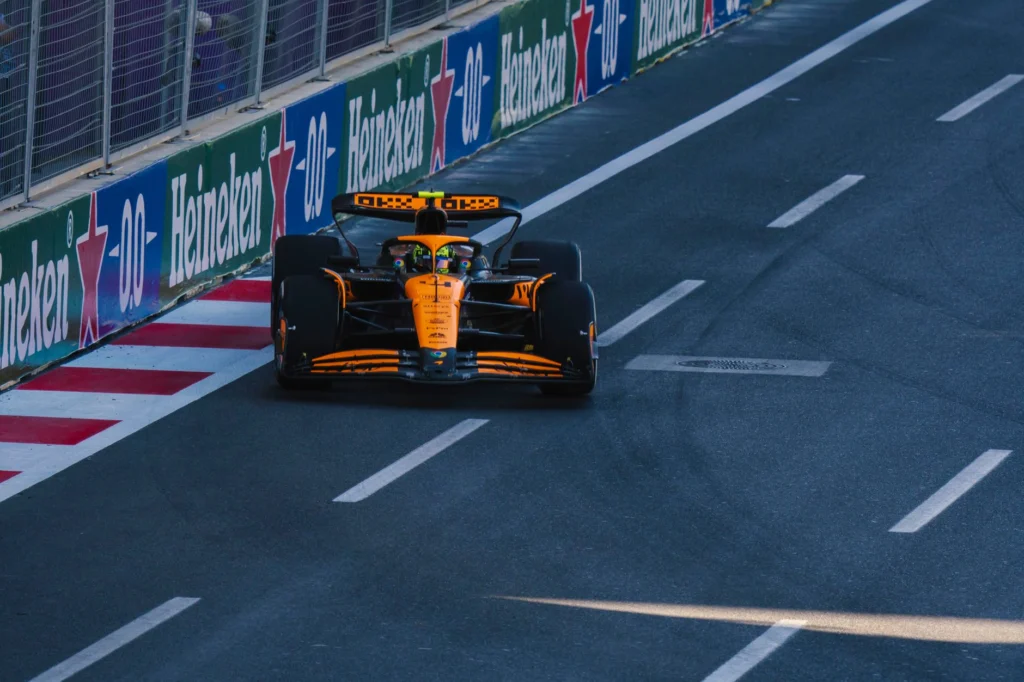
Lando Norris did not win the 2026 Dutch Grand Prix by controlling it from pole. He won after Kimi Antonelli took the lead at the second standing start, held Norris behind him for much of the race, and then lost the advantage created by Mercedes' strategy decisions.
The final result looked straightforward: Norris won, Antonelli finished second and George Russell completed the podium. But the 72-lap race at Zandvoort was effectively decided in several different stages, with tyre choice and pit-stop timing repeatedly changing who had the advantage. (formula1.com)
That makes the Norris-Antonelli battle more interesting than the finishing order suggests. Antonelli had the track position. Norris eventually had the better tyre performance. The late Virtual Safety Car then forced Mercedes to make a decision that gave Antonelli fresh tyres but also dropped him behind his team-mate.
Antonelli won the restart, even though Norris started on pole
Norris began from pole with Russell and Antonelli alongside him in the Mercedes cars, and he initially retained first place. Antonelli immediately moved ahead of Russell.
Then Max Verstappen's home race ended on the opening lap. The Red Bull driver lost the rear of his car after running a wheel across the white line on the main straight and hit the wall, bringing out the red flag. (formula1.com)
The restart changed the race.
Antonelli made the better launch and passed Norris for the lead. It was a particularly valuable gain at Zandvoort because following closely there does not automatically translate into an easy overtaking opportunity. Antonelli could therefore use his position at the front to dictate the pace and keep Norris outside the most useful range for an immediate attack.
Antonelli later described his two strong starts as having effectively “saved” his race, reflecting how important those moments were to his result. (formula1.com)
The first strategic battle, then, was not really about the pit wall. Mercedes had already gained something valuable before either leading driver made a stop: track position.
The first stint showed why Norris needed a different approach
The leading group had not started on identical tyres. Norris, Antonelli, Russell and several other frontrunners began on the medium compound, while much of the field chose softs and the two Cadillacs started on hards. The medium runners were therefore positioned around a conventional one-stop race rather than an immediate tyre gamble. (formula1.com)
Antonelli gradually extended his advantage over Norris to around 1.4 seconds. That mattered because Norris needed to be within one second to access Overtake Mode. Once the gap moved beyond that threshold, the Mercedes driver had more freedom to manage the race without facing an immediate attack.
Norris was also reporting that his tyres were running out of performance. By Lap 16, he told McLaren he was at “pace zero” and had nothing more to give. (formula1.com)
That made the first pit-stop cycle crucial. If Norris simply remained behind Antonelli, Mercedes had a chance to keep control through track position. McLaren instead needed the hard tyre to change the relative performance of the two cars.
Antonelli and Norris both stopped on Lap 22 and switched to hards. Both pit stops were slower than the teams would have wanted, so neither side received a perfectly clean execution. But the important change came after the tyre swap: Norris was significantly more competitive in the second stint. Sky Sports reported that he was much quicker on the hard compound, allowing him to begin closing the gap that Antonelli had built earlier. (skysports.com)
The battle had therefore shifted from who could control the track to whose tyres could sustain the pace.
Norris lost track position but gained the better attacking position
Norris' second strategic phase was more complicated because McLaren eventually stopped him again on Lap 48.
He had been leading by roughly 10 seconds at that point, but the second stop dropped him back to third, more than five seconds behind Antonelli. On paper, that looked like a setback. In practice, it gave Norris a major advantage: much fresher tyres for the closing stages. (formula1.com)
The gap disappeared quickly.
Within three laps, Norris had reduced the deficit to Antonelli to about 1.4 seconds. By Lap 52 he was close enough to attack, although Antonelli still had a defensive advantage because he was within one second of Lewis Hamilton and could use Overtake Mode.
That did not save him for long.
On Lap 54, Norris passed Antonelli into Turn 1. Norris later described the move as the one that effectively won him the race. (formula1.com)
The significance was strategic as much as technical. Norris had spent much of the race behind Antonelli because the Mercedes had the superior track position. Once the tyre-age difference became large enough, that advantage stopped being sufficient.
The VSC turned Mercedes' problem into a different one
Antonelli's most consequential strategic decision came only after Norris had taken the lead.
Ocon stopped his Haas on track, triggering a Virtual Safety Car. Mercedes brought Antonelli into the pits for soft tyres, gambling that the time-saving neutralisation would make the stop worthwhile. (formula1.com)
It was a logical move in one respect. Antonelli was fighting for second rather than trying to pass Norris on worn tyres, and a set of fresh softs offered substantially more performance for the final part of the race.
But the stop had a cost: Antonelli rejoined behind Russell.
At Zandvoort, that was not an insignificant detail. Passing another competitive car is difficult, so Mercedes now had a problem that did not exist before the VSC. Antonelli had the faster tyre, but Russell had the track position.
Mercedes eventually instructed Russell to let Antonelli through. Russell later defended the decision, saying his team-mate deserved to finish ahead, while Mercedes boss Toto Wolff argued that the call was straightforward given Antonelli's championship position. (espn.com)
The move preserved Antonelli's second place, but it also exposed the central difference between his race and Norris' race.
Norris did not pit under the VSC.
That left him on older tyres, but it also left him in clean air with no car ahead to pass.
Norris' decision not to stop was riskier than the final margin suggests
Norris' radio message during the VSC showed that McLaren understood the risk. He questioned whether he needed to take the stop, but by then the VSC was ending. He stayed out.
When racing resumed on Lap 58, Norris had a lead of 6.8 seconds over Russell, with Antonelli a further 5.6 seconds behind. (formula1.com)
The obvious assumption would be that Antonelli's fresh soft tyres should make the final stint dangerous for Norris. Instead, Norris pulled away.
That is perhaps the clearest indication of how well McLaren had judged the trade-off. Norris had older tyres, but he also had clean air and no need to spend laps overtaking Mercedes machinery. Antonelli, meanwhile, had to clear Russell before he could even think about chasing the leader.
By the final 10 laps, Antonelli had reduced the gap to Russell to 2.4 seconds, but Norris remained roughly 10 seconds ahead. The fresh-tyre advantage was useful for securing second place, not enough to reopen the fight for victory. (formula1.com)
Norris ultimately won by 11.536 seconds, with Antonelli second and Russell third. (formula1.com)
The Dutch GP showed two different ways to win a strategic battle
Antonelli's race was built around defending a position he had earned at the restart. His early pace and track position kept Norris behind him through the first stint, and his strong launches were decisive in recovering from the initial disadvantage of starting behind Norris.
Norris had to solve a different problem. He could not simply sit behind the Mercedes and wait for an easy opportunity. McLaren's hard-tyre pace gave him the ability to close the gap, while the second stop gave him the tyre advantage required to attack decisively.
The late VSC then presented the final strategic choice. Mercedes took the opportunity to put Antonelli onto softs. McLaren kept Norris on track.
That decision looked uncomfortable on the timing screens but worked because Norris had already established track position and enough pace to create a buffer before the final laps. Antonelli's fresh tyres ultimately protected second place rather than giving him a realistic shot at first.
The championship implications were significant. Antonelli extended his lead over Norris to 83 points after finishing second, although Norris' second consecutive victory strengthened his title defence. (skysports.com)
But the more revealing part of Zandvoort was what happened before the points were counted. Antonelli won the first strategic contest by taking the lead at the restart. Norris won the longer one by turning tyre performance into track position, then refusing to give that position back when the final VSC appeared.
At Zandvoort, strategy did not simply decide who stopped when. It changed what each driver needed to do to win. Norris needed patience before he could attack. Antonelli needed clean air before his fresh tyres could matter. Once those conditions reversed, so did control of the race.
If your company or product is mentioned in this article, you're welcome to share it.