Yumble is no longer in business. The company that appeared on Shark Tank in 2018 as a subscription service for freshly prepared children’s meals eventually changed ownership, changed its product, and finally disappeared.
The most important detail is also one that gets repeated incorrectly: Bethenny Frankel’s $500,000 Shark Tank deal never closed.
That did not stop Yumble from raising outside capital and growing for several years. In September 2018, shortly before its Shark Tank episode aired, Yumble announced that it had raised a total of $8.5 million from investors including Sonoma Brands and Danone Manifesto Ventures. (prnewswire.com)
The company ultimately lasted beyond its television moment, but not indefinitely. Its original business ended in late 2022. A different company then revived the Yumble name with a very different product. That second version also closed, with General Mills' G-Works announcing in February 2024 that it would no longer pursue Yumble as a brand. (foodrepublic.com)
Yumble asked the Sharks for $500,000 for 4%
When David and Joanna Parker entered the Shark Tank set, Yumble was selling prepared meals designed specifically for children.
The company had launched in 2017 after Joanna Parker's experience trying to feed three children nutritious food that they would actually eat. David Parker and Joanna built the service around a straightforward proposition: parents could order meals for their children that arrived ready to eat, eliminating most of the preparation associated with feeding a family. TechCrunch reported that the meals required little more than reheating and that Yumble offered 22 choices per week. (techcrunch.com)
By the time of the Shark Tank pitch, the numbers were substantial for a young food startup.
The Parkers said Yumble had generated $1.3 million in sales, with monthly growth of roughly 30%. The meals sold for approximately $6.99 to $7.99, including shipping. (forbes.com)
They asked the Sharks for $500,000 in exchange for 4%, implying a $12.5 million valuation.
The pitch attracted several offers. Rohan Oza offered $500,000 for 12% and proposed bringing Lori Greiner into the deal. Bethenny Frankel initially offered $500,000 for 15%, then cut her demand dramatically.
Her final offer was $500,000 for 6%.
The Parkers accepted. (forbes.com)
On television, it looked like Yumble had secured its Shark.
It hadn't.
Bethenny Frankel never actually invested the $500,000
The $500,000 for 6% is one of the most commonly repeated facts about Yumble, but describing it as an investment is misleading.
Joanna Parker later confirmed that Frankel never completed the deal. The Shark Tank agreement was made on camera, but the transaction did not close after the episode. (thedailymeal.com)
The reason the deal fell apart has not been publicly established in a sufficiently reliable source to state it as fact.
That distinction matters because many Shark Tank updates treat every on-camera deal as money that actually changed hands. In Yumble's case, it didn't.
The company nevertheless had enough traction to continue without Frankel's capital.
Yumble had already attracted institutional investors. Danone Manifesto Ventures, the venture arm of Danone, had invested in the company in 2018, and Yumble's September 2018 funding announcement put its total capital raised at $8.5 million. (corporate.danone.co.za)
So the Shark Tank outcome was less a story of a company receiving $500,000 from Bethenny Frankel and more a story of a company receiving television exposure while continuing to finance itself through conventional venture investment.
Yumble kept growing, but the original meal-delivery model did not last
For several years after Shark Tank, Yumble continued operating as the business viewers remembered: a direct-to-consumer service built around prepared food for children.
The company expanded its menu and customer base, and eventually introduced Yumble Up, a larger-portion offering aimed at older children after customers complained that some of the original portions were too small. Contemporary Shark Tank reporting put Yumble's annual revenue at around $8 million in 2022, although revenue figures reported by secondary sources vary, so that number should be treated as a reported figure rather than an audited result. (sharktankblog.com)
There was a meaningful difference between Yumble's early promise and the economics of scaling it.
Shipping prepared food to families is an operationally demanding business. Food has to be produced, packaged, kept within appropriate conditions and delivered reliably. Customer acquisition adds another expense, while the company still has to make money on each meal after food, packaging, labor and fulfillment.
Yumble managed to build a real business around the model. But it did not ultimately produce a durable standalone company.
By December 2022, the original Yumble operation had stopped.
Dibz Kidz bought the Yumble name and tried a very different business
This is where the Yumble story gets confusing.
The original Yumble was acquired by Dibz Kidz in December 2022 for an undisclosed amount, according to multiple later reports. The new owners did not simply continue shipping the same freshly prepared meals that the Parkers had built. (foodrepublic.com)
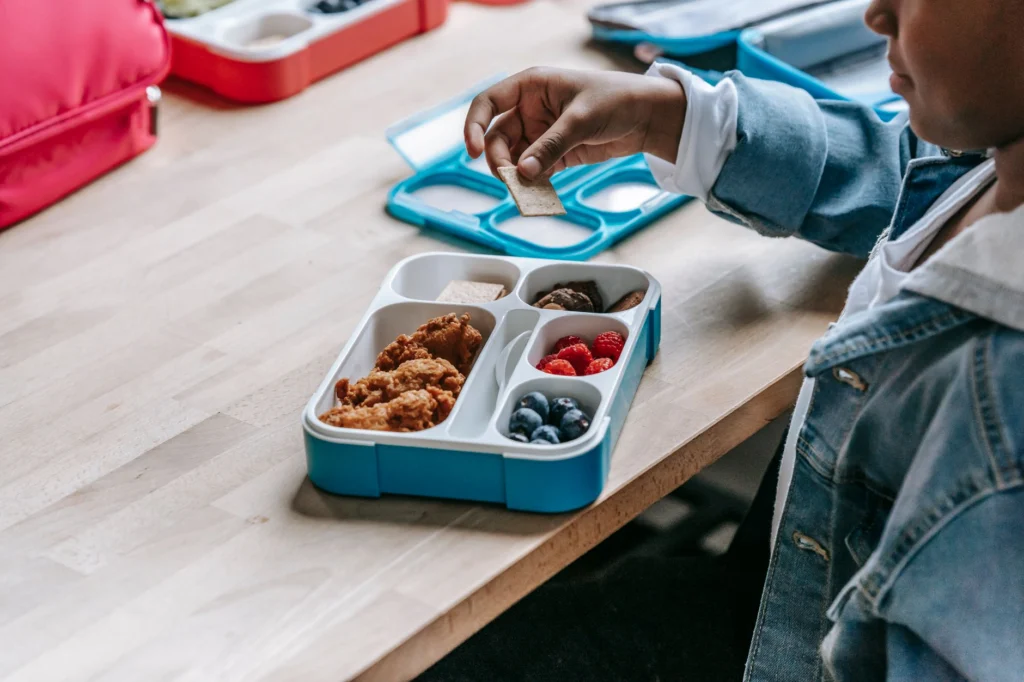
Instead, Yumble returned in 2023 with shelf-stable school lunches, snack packs and customizable lunch bags.
That was a substantial change.
Rather than receiving proprietary prepared meals developed by the original Yumble team, customers could build lunch bags around packaged products and snacks. The new operation was much closer to a curated lunch-box service than the fresh-meal subscription that had appeared on Shark Tank. (foodrepublic.com)
The change was not necessarily a quiet one. General Mills' own corporate site published a detailed account of the new Yumble in August 2023, describing it as a G-Works innovation project and saying the service offered more than 2,800 possible lunch combinations. Ready-to-go lunches and build-your-own options were priced at $5.99, while snack packs ranged from $3.99 to $4.99. (privacy.generalmills.com)
That General Mills account is useful because it establishes that the later Yumble was not simply an internet rumor or a dormant brand being recycled by third-party sites. General Mills publicly described its involvement and the product being tested.
The company also began selling through Walmart.com in late 2023, according to reporting at the time. (foodrepublic.com)
But the relaunch did not last.
General Mills ultimately stopped pursuing Yumble
In February 2024, the second version of Yumble announced that it was closing.
The explanation available from the company's own public statement was unusually straightforward: G-Works, General Mills' internal innovation group, had decided not to pursue Yumble as a brand. Customers were thanked for their support, and the company said orders and subscriptions would be reimbursed. (foodrepublic.com)
General Mills' August 2023 announcement makes the chronology especially interesting. It described Yumble as a brand being launched and tested through G-Works, rather than presenting it as the continuation of the Parker family's original operating company. (privacy.generalmills.com)
That helps explain why some online accounts appear contradictory.
Some describe Yumble as a company acquired by Dibz Kidz and subsequently shut down. Others describe General Mills' G-Works as the organization behind the final Yumble product. Both pieces of the later history appear in the public record, but the ownership and corporate relationships are not documented clearly enough in primary sources to confidently reconstruct every transaction between Dibz Kidz and General Mills.
What can be established is simpler: the original Yumble business ended, the Yumble name returned with a substantially different lunch-kit model, General Mills publicly supported that iteration through G-Works, and that version was abandoned in February 2024.
So, what happened to Yumble after Shark Tank?
Yumble did not become a Shark Tank breakout.
The Parkers asked for $500,000 for 4%, accepted Bethenny Frankel's $500,000-for-6% offer, and then did not complete the transaction. Instead, Yumble continued with other investors and built a business that reached millions of dollars in reported annual revenue.
But the original model eventually ended in 2022.
The Yumble name then moved into a second act built around shelf-stable school lunches, packaged snacks and customizable lunch bags. General Mills' G-Works publicly tested that concept in 2023, including a Walmart distribution relationship, but the experiment was short-lived.
By February 2024, Yumble was finished.
There is no credible basis for describing the company as an active Shark Tank success in 2026. The more accurate story is less tidy: Yumble built a genuine venture-backed kids' food business, received a high-profile but ultimately uncompleted Shark Tank deal, survived for years without its Shark, changed hands, reinvented its product, and then disappeared anyway.
The $500,000 television deal was never the money that made Yumble's story. The $8.5 million it had raised from outside investors before the episode aired was real. So was the eventual shutdown.
That is the part of the Yumble story that the Shark Tank deal tends to obscure.
If your company or product is mentioned in this article, you're welcome to share it.