Bantam Bagels did not get acquired by Starbucks.
That distinction matters because the company’s story is often retold as if its nationwide presence inside Starbucks stores eventually led to a Starbucks acquisition. The actual deal was different. Starbucks became Bantam Bagels’ largest and most important foodservice customer. In October 2018, the company itself was acquired by Lancaster Colony Corporation, through its wholly owned subsidiary T. Marzetti Company.
The acquisition was not a vague Shark Tank success-story payout either. Lancaster Colony disclosed the transaction publicly: it acquired all assets of Bantam Bagels on October 19, 2018. The announced base purchase price was about $34 million, subject to post-closing adjustments, with an additional earn-out tied to future financial performance. Later financial disclosures put the adjusted base purchase price at $33.1 million.
The more interesting story is that Bantam Bagels' biggest commercial breakthrough, Starbucks, was also connected to its eventual collapse.
Shark Tank gave Bantam Bagels the capital and attention it needed
Nick and Elyse Oleksak founded Bantam Bagels in New York City in 2013. Their product was simple enough to explain in one sentence: miniature bagels with cream cheese and other fillings baked inside.
The couple appeared on Shark Tank in 2015 seeking $275,000 for an 11% stake in the company. Lori Greiner ultimately agreed to invest $275,000 for 25%.
At the time, Bantam Bagels was still a young New York business. But the television appearance dramatically expanded its audience. The company later moved from a small West Village operation toward national retail and foodservice distribution.
By 2016, Bantam Bagels had reached the kind of distribution deal most small food companies spend years chasing.
Starbucks began selling the products nationally.
Starbucks helped turn Bantam Bagels into a national brand
The Starbucks relationship began with testing before the national rollout.
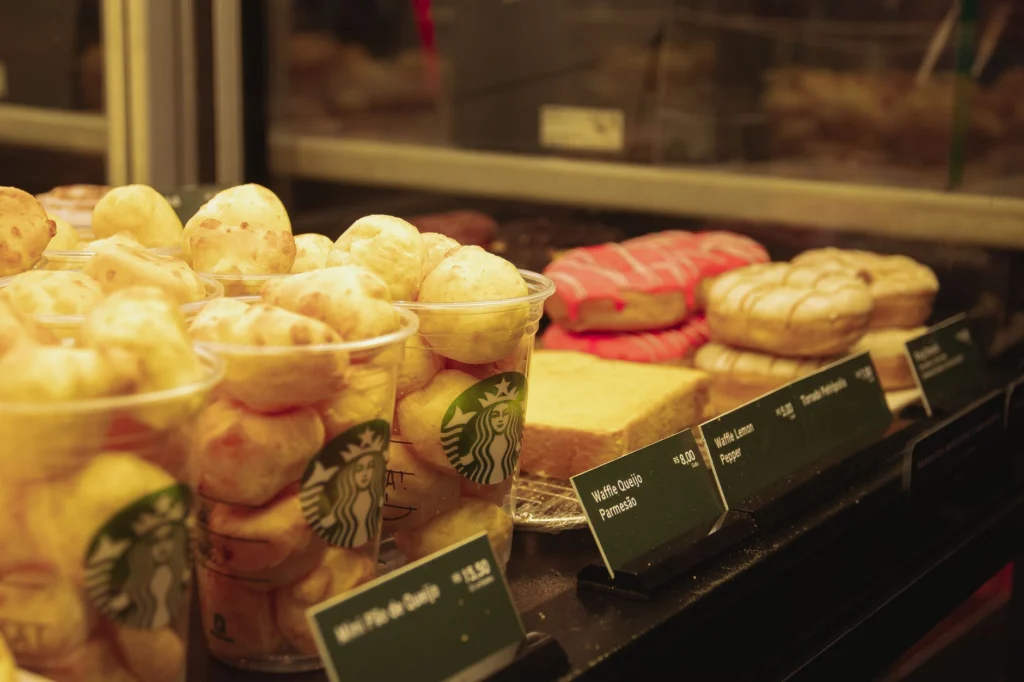
Bantam Bagels had been sold in selected Starbucks locations before the broader expansion. In September 2016, the company announced that its products would become available in more than 7,000 company-operated Starbucks stores across the United States. Contemporary reporting put the broader Starbucks distribution figure above 7,700 locations.
For a small food company, that was an extraordinary jump in distribution.
Bantam Bagels was no longer dependent on customers walking into its New York store. Its mini stuffed bagels were suddenly sitting inside thousands of Starbucks locations, alongside the coffee chain's own food offerings.
The company also expanded into grocery retail. Its frozen products reached stores including Kroger, Safeway, QFC and Fred Meyer.
But Starbucks was especially important because it gave Bantam a recurring foodservice channel with enormous scale.
The company’s relationship later became one of the central facts behind Lancaster Colony's decision to buy the company.
Lancaster Colony, not Starbucks, acquired Bantam Bagels in October 2018
Lancaster Colony Corporation announced the acquisition of Bantam Bagels in October 2018.
Its subsidiary, T. Marzetti Company, acquired all assets of Bantam Bagels, with the transaction closing on October 19, 2018. Lancaster Colony initially described the base purchase price as $34 million, subject to post-closing adjustments, plus contingent consideration through an earn-out tied to future performance.
In later financial reporting, Lancaster Colony disclosed a base purchase price of $33.1 million including the post-closing working-capital adjustment. The company also said the acquisition included an additional performance-based earn-out, with no stated minimum or maximum value.
That is the closest thing to a definitive answer on the deal's value.
You will sometimes see a flat "$34 million acquisition" figure repeated online. That figure comes from Lancaster Colony's original announcement. The company's later accounting disclosure reported the adjusted base purchase price as $33.1 million, while the possible earn-out meant the total eventual consideration could have been higher.
The founders were expected to continue leading the business after the acquisition. Lancaster Colony saw Bantam as an entry into the frozen breakfast category and specifically highlighted its relationship with Starbucks as a strategic advantage.
In other words, Starbucks was valuable to Bantam's buyer precisely because Starbucks was already a major customer.
The Starbucks relationship was an asset, not an acquisition
This is where the commonly repeated version of the story goes wrong.
Starbucks did not buy Bantam Bagels. There is no Starbucks acquisition announcement or corporate filing showing that Starbucks purchased the company.
Instead, Bantam Bagels sold its products through Starbucks.
Lancaster Colony's own acquisition announcement described Bantam's Starbucks relationship as an established foodservice advantage. Its later financial filings similarly noted that Bantam Bagels products were available at corporate-owned Starbucks cafés nationwide.
That distinction may sound technical, but it completely changes the acquisition story.
Bantam Bagels was not a Shark Tank company that got bought by Starbucks. It was a Shark Tank company that secured Starbucks as a massive distribution partner and was then acquired by a publicly traded specialty-food company.
And eventually, losing that major customer became one of the reasons the business could no longer continue.
The pandemic changed the economics of Bantam Bagels
Lancaster Colony acquired Bantam Bagels before anyone knew what the next two years would bring to restaurants and foodservice.
When COVID-19 disrupted the restaurant industry, many operators simplified their menus. Store closures and lower traffic changed the economics of products that depended heavily on foodservice distribution.
Lancaster Colony later explained that Bantam Bagels had been discontinued by its largest customer during the pandemic as restaurant operators streamlined their menus.
The company did not identify the customer in that statement. But given Lancaster Colony's repeated descriptions of Starbucks as Bantam's major foodservice relationship and the nationwide Starbucks distribution, the loss of Starbucks has widely been understood as the critical commercial blow. What Lancaster Colony stated definitively was that the loss of its largest customer changed the economics of the business.
The company tried to grow Bantam in retail and replace the lost foodservice business.
It did not work.
Lancaster Colony exited the Bantam Bagels business in 2022
In 2022, Lancaster Colony announced that it would exit the Bantam Bagels business.
The company cited financial underperformance and said it could not identify a credible path to profitability. Lancaster Colony recorded a noncash restructuring and impairment charge related to the business and planned to complete its exit by the end of June 2022.
That was an unexpectedly sharp ending for one of Shark Tank's more recognizable food brands.
Bantam Bagels had gone from a small New York shop to national television, then to thousands of Starbucks stores, grocery shelves and eventually a multimillion-dollar acquisition.
But scale had created dependence as well as opportunity.
The Starbucks relationship helped make Bantam Bagels attractive to a corporate buyer. When the business later lost its biggest foodservice customer during the pandemic-era disruption of restaurant menus, the economics changed in the opposite direction.
That is the real acquisition story.
Bantam Bagels was never bought by Starbucks. It was built, in part, through Starbucks. Then Lancaster Colony bought the company for roughly $34 million in base consideration, plus a potential earn-out. Four years later, the same foodservice dependency that had helped make Bantam valuable had become too difficult to replace.
That is a much less tidy ending than the usual Shark Tank success story. It is also the one supported by the record.