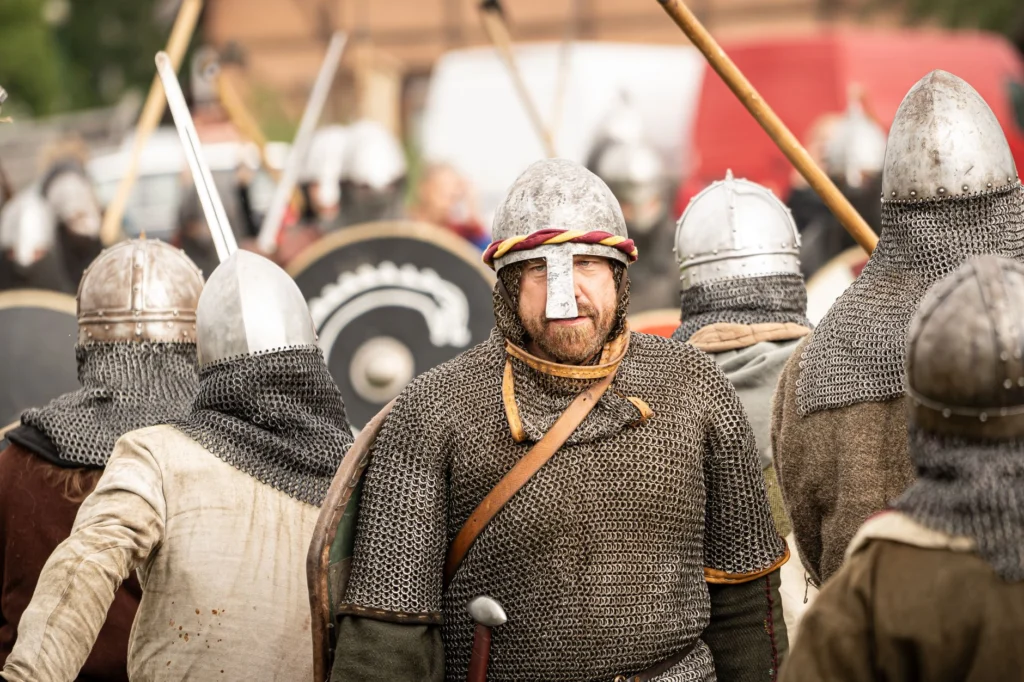
Ask someone to picture a Viking, and the image arrives instantly: a bearded raider in a helmet with two curved horns jutting from the sides. It’s on movie posters, sports mascots, and Halloween costumes. It is also, as far as actual archaeological evidence goes, completely made up — no confirmed Viking-Age burial or settlement has ever produced a horned helmet intended for combat, and the real story of where the image came from is a better one than the myth itself.
What Vikings actually wore on their heads
The archaeological record for Viking helmets is thin but consistent, and none of it includes horns. The most complete Viking-Age helmet ever discovered came from a farm excavation in Norway in the 1940s — a simple iron cap with a nose guard, functional and unremarkable by design, exactly what you’d expect from something built to survive a sword blow rather than look impressive on a stage. Surviving artwork and carvings from the period show Viking-Age warriors either bareheaded or wearing plain iron or leather helmets. Horns would have been a genuine liability in actual combat — something for an opponent to grab, and extra weight and surface area with no protective benefit.
So where did the myth actually come from
The image traces to a specific, datable source: 19th-century Scandinavian Romantic-era artists, who were reimagining Viking-Age warriors for a nationalist and artistic movement looking to give Scandinavia a dramatic, ancient visual identity. The image that actually cemented the myth in global popular culture, though, came from theater, not archaeology — costume designers working on Richard Wagner’s opera cycle Der Ring des Nibelungen, first staged in 1876, created elaborate horned helmets specifically to make ancient Germanic warriors look suitably fierce and mythic under stage lighting. Within about 25 years of the production, horned helmets had become visually synonymous with Scandinavian raiders in the popular imagination — a costume decision from a 19th-century opera outlasting the actual historical evidence by well over a century.
The twist: horned helmets did exist — just not for Vikings
Here’s the detail that makes this more than a simple debunking: horned helmets are real archaeological objects. They just belong to a completely different culture and era — Bronze Age Scandinavia and northern Europe, roughly 900 BCE, more than 2,000 years before the Viking Age even began. These helmets, ceremonial rather than combat gear, are genuine artifacts of a much older culture, and they appear to have been ritual or decorative objects rather than battlefield equipment. The Victorian and Romantic-era artists weren’t inventing horned helmets from nothing — they were almost certainly borrowing an image from a completely unrelated, much older culture and reattaching it to the Vikings because it fit the dramatic image they wanted to create.
Why this particular myth stuck so hard
Most historical myths fade once they’re corrected in a textbook. This one has survived over a century of archaeologists explicitly stating there’s no evidence for it, and the reason is worth naming: the horned helmet is a genuinely good piece of visual design — instantly readable, dramatic, easy to reproduce as a logo or costume. Historical accuracy and visual memorability aren’t the same thing, and when they conflict, memorability tends to win in popular culture regardless of what the archaeological record actually shows. The real Viking helmet — plain iron, a simple nose guard, built to survive a fight rather than look striking from a distance — never had a chance against a 19th-century opera designer’s imagination.