

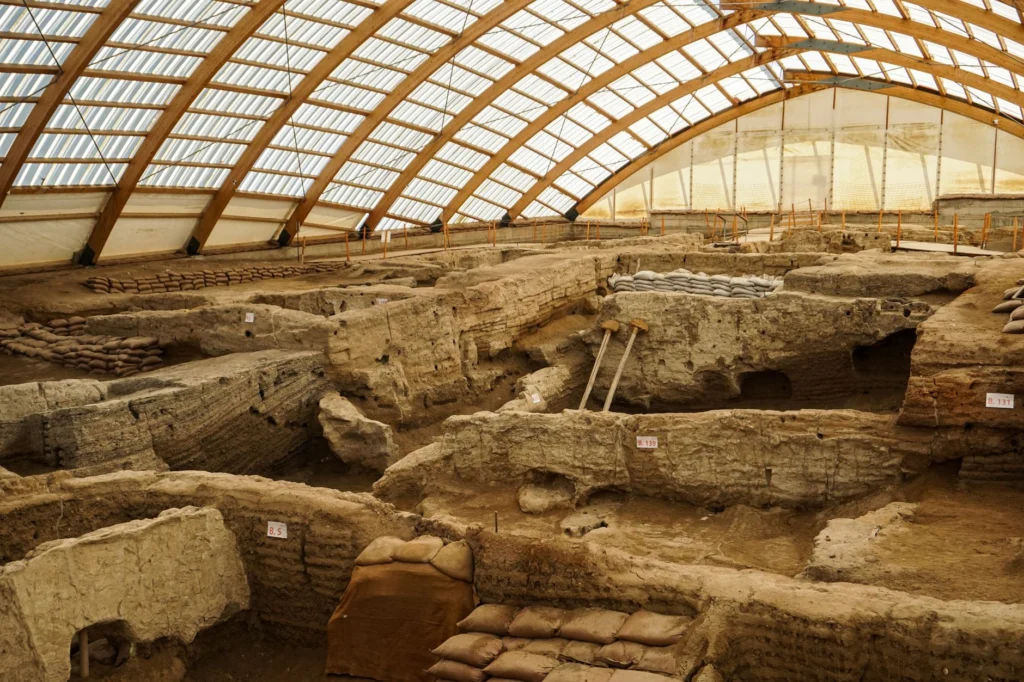
Ancient architecture gets appreciated primarily as engineering achievement or aesthetic accomplishment, but archaeologists and historians studying these structures treat them as a genuinely rich data source about how ancient societies were actually organized — labor structures, social hierarchy, resource distribution — often more directly informative than surviving written records from the same era, which frequently reflect only the perspective of a literate ruling class.
Construction scale reveals labor organization capacity directly
The sheer coordinated labor required to construct a monumental structure — the Great Pyramid of Giza, for instance, required organizing, housing, and feeding a large, sustained workforce over an extended construction period — provides archaeologists with direct physical evidence about a society’s administrative and logistical capacity, independent of and often more reliable than any surviving written claims about that same society’s organizational sophistication, since the physical structure itself is direct, undeniable evidence of the coordination capacity required to build it.
Spatial layout reveals social hierarchy with unusual clarity
The physical layout of ancient settlements and monumental complexes — which structures occupy the most prominent or defensible locations, the size differential between elite and common dwellings, the presence and placement of dedicated ceremonial or administrative spaces — gives archaeologists a genuinely detailed picture of a society’s social stratification that often survives far more completely and objectively in the physical record than in written accounts, which were frequently produced by and for the same elite class the architecture itself was built to serve and reinforce.
A society’s buildings don’t just show what it could construct. They show, in remarkably durable physical form, who that society answered to and how its labor and resources actually flowed.
Why this evidence is considered unusually reliable
Architectural and archaeological evidence carries a specific methodological advantage over many other historical source types: it’s considerably harder to deliberately falsify or bias after the fact compared to written records, which can be selectively preserved, destroyed, or written with specific propagandistic intent by the ruling powers who controlled literacy and record-keeping — making architectural remains, imperfect and incomplete as they are, an unusually direct and comparatively less distorted physical record of how ancient societies actually organized their labor, resources, and social hierarchy.