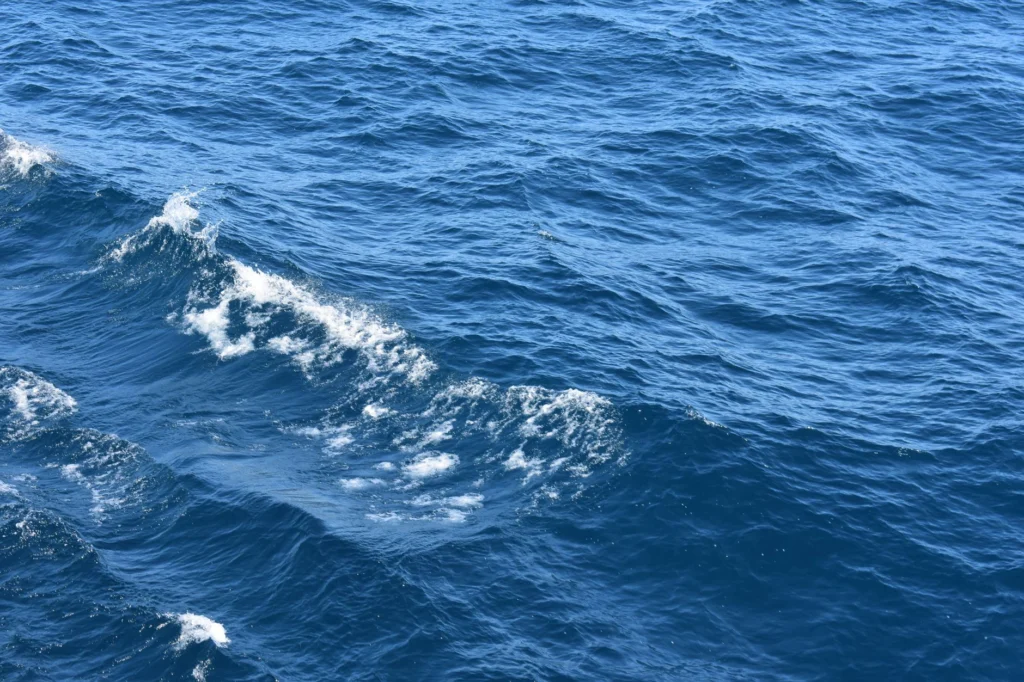
The Pacific isn’t just the largest ocean — it’s larger than every continent on Earth combined, a fact that’s easy to state and genuinely hard to fully grasp. Here are the real numbers behind it.
It’s bigger than all the world’s land combined
The Pacific Ocean covers more than 60 million square miles (155 million square kilometers) — more than 30% of Earth’s entire surface, and genuinely larger than the landmass of every continent on the planet added together. It contains almost twice as much water as the Atlantic Ocean, the world’s second-largest.
It holds nearly half of all the water on Earth
NOAA reports the Pacific accounts for 49.4% of all the water in the global ocean — meaning essentially one single ocean basin holds close to half of the water on the entire planet, a real, staggering concentration in one body.
Its average depth alone would swallow most mountains
The Pacific averages a depth of 13,000 feet (4,000 meters) — deep enough that most of the world’s tallest mountains, laid sideways at the bottom, would still be covered by water at the ocean’s average depth, let alone its deepest points.
It contains the deepest place on Earth
The Mariana Trench, located in the Pacific, holds Challenger Deep — the deepest known point on the planet, extending more than 36,000 feet (roughly 11,000 meters) below the surface. That’s deep enough to fully submerge Mount Everest with more than a mile of ocean still remaining above its peak.
The Pacific is still growing narrower, not wider
Despite its enormous current size, the Pacific is actually shrinking geologically, a real and counterintuitive fact tied directly to plate tectonics: the ocean floor along much of the Pacific’s edge is being subducted — pulled downward and consumed — beneath the surrounding continental plates faster than new seafloor is being created at its mid-ocean ridges. That’s the literal mechanism behind the Pacific “Ring of Fire,” the real, continuous chain of volcanic and earthquake activity circling the ocean’s edge, caused by exactly the same plate movement that’s slowly reducing the ocean’s total size over geological time — a process measured in centimeters per year, but real and ongoing.
Why the real scale matters
It’s easy to treat “world’s largest ocean” as a throwaway superlative, but the actual numbers behind the Pacific make clear it’s not a close contest: nearly half of the planet’s water, an area larger than all land on Earth combined, and the single deepest point ever measured — all in one connected body of water most people will only ever see a tiny fraction of.
It touches more countries and territories than any other ocean
The Pacific’s real coastline borders more nations and island territories than any other ocean basin — the entire western edge of the Americas, the eastern coast of Asia, Australia, and thousands of individual Pacific island nations and territories scattered across Oceania. That real geographic reach is part of why the Pacific hosts an unusually large share of the world’s tsunami and earthquake monitoring infrastructure — a direct, practical response to sitting at the center of the Ring of Fire, the same tectonic activity responsible for roughly 90% of the world’s earthquakes and a majority of its active volcanoes.
Its remotest point is the hardest place on Earth to reach
Point Nemo, located in the South Pacific, is the real, calculated point on Earth’s ocean surface that sits farthest from any land — more than 1,600 miles from the nearest coastline in any direction. It’s so remote that astronauts aboard the International Space Station, orbiting roughly 250 miles overhead, are frequently the closest humans to that exact point on the ocean’s surface — a genuinely strange, verifiable fact about just how much open water the Pacific actually contains.