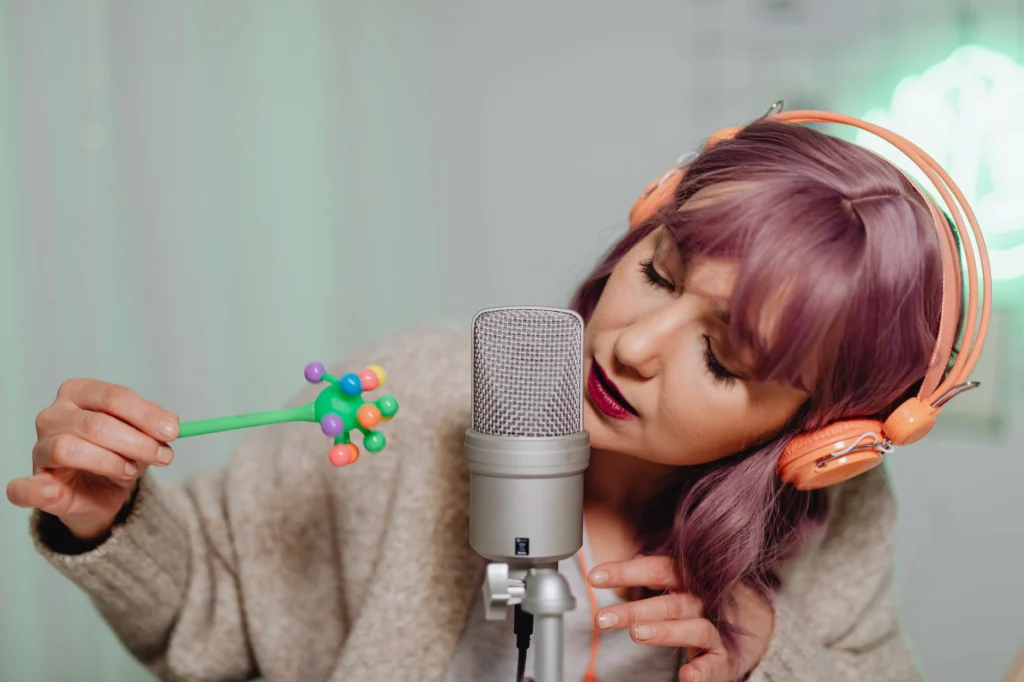
Whispering, tapping, page-turning, hair-brushing sounds — to a meaningful share of the population, videos built entirely around these sounds are a billion-view internet category, reliably producing a tingling sensation that starts at the scalp and runs down the neck and spine. To another, equally large share of the population, the same videos produce nothing at all, or mild discomfort. That split is itself one of the more interesting facts about ASMR: it’s not that the effect is universally faked or universally felt — it’s a real, measurable phenomenon that a meaningful portion of people simply don’t experience.
What ASMR actually is, and where the research started
Autonomous Sensory Meridian Response — ASMR — describes a perceptual phenomenon in which specific auditory and visual triggers reliably produce a tingling sensation in the head and neck, often extending down the back and limbs, along with a feeling of calm or mild euphoria. The term itself is relatively new, coined online in the early 2010s as the video category exploded, but the first serious academic study came in 2015, when researchers Emma Barratt and Nick Davis published “Autonomous Sensory Meridian Response (ASMR): a flow-like mental state” in the journal PeerJ — the study that effectively moved ASMR from internet subculture into a legitimate subject of psychological research.
Barratt and Davis’s survey-based findings were striking in their consistency: among self-identified ASMR experiencers, 98% reported that ASMR videos helped them relax, 82% said they helped with sleep, 70% used them to cope with stress, and 80% reported that the experience left them feeling more positive. Those aren’t marginal effects — they describe a population using this content as a genuinely functional tool for a specific physiological and emotional outcome, not just idle entertainment.
What brain imaging actually shows
The more scientifically interesting evidence comes from functional MRI research examining what’s actually happening in the brain during an ASMR response. Studies have found that the tingling sensation is associated with activity in brain regions involved in reward processing, social bonding and empathy — specifically including the nucleus accumbens, a structure central to the brain’s dopaminergic reward pathway, alongside the anterior cingulate gyrus, insula and inferior frontal gyrus. The involvement of the nucleus accumbens specifically is significant: it’s the same reward-pathway structure implicated in the brain’s response to many other genuinely pleasurable, reinforcing experiences, which gives real neurological grounding to the subjective reports of pleasure and relaxation ASMR experiencers describe, rather than leaving it as a purely self-reported, unverifiable claim.
Why some people feel nothing at all
This is the part of the ASMR story that keeps it from being a simple “it’s real” or “it’s fake” binary. Research consistently finds that ASMR is not a universal human experience — a meaningful portion of the population reports no tingling response to trigger content at all, and personality research has found real, measurable differences between those who experience it and those who don’t. ASMR-sensitive individuals tend to score higher on Openness to Experience and, in some studies, higher on neuroticism, while scoring lower on conscientiousness, extraversion and agreeableness compared to non-experiencers. Other research has linked ASMR-proneness to differences in emotion-regulation style, specifically a greater tendency toward cognitive reappraisal — actively reframing how you interpret and respond to a sensory or emotional experience — as a coping strategy.
The most likely explanation isn’t that some people are imagining the effect and others aren’t. It’s closer to how researchers currently frame it: a genuine perceptual and personality-linked trait, distributed across a spectrum, with underlying differences in neurotransmitter receptor sensitivity proposed as one possible biological mechanism for why the same whispered, tapping, or crinkling sound produces a tingling wave of calm in one person and simply nothing — or mild irritation — in another.
What real skepticism about ASMR actually looks like
The legitimate scientific skepticism here isn’t “ASMR doesn’t exist.” It’s a narrower, more useful set of open questions: how much of the reported relaxation effect is a genuine, distinct sensory-neurological response versus a placebo-like effect driven by expectation and context; how reliably the tingling sensation itself can be measured objectively rather than through self-report; and how much individual variation in trigger preference and intensity complicates building a single, unified model of what’s actually happening. Researchers in the field are generally direct about this: ASMR is real and measurable in aggregate, and genuinely not yet fully understood at the level of a precise, complete neurological mechanism — a combination that’s honestly true of a lot of psychological and sensory science, not a special mark against ASMR specifically.
The actual takeaway
ASMR is a real, peer-reviewed, brain-imaging-supported phenomenon — not a manufactured internet trend dressed up in pseudoscientific language. It activates the same reward pathway implicated in other genuinely pleasurable experiences, and self-reported benefits around relaxation, sleep and stress are consistent enough across research to take seriously as a real, functional effect for the people who experience it. What keeps it from being a simple universal claim is that a substantial share of people don’t experience it at all, in ways that trace to measurable, real personality and processing differences rather than simple skepticism or lack of exposure. If a whispering video does nothing for you, that’s not you missing something obvious — it’s a real, documented difference in how different brains respond to the same sensory input.