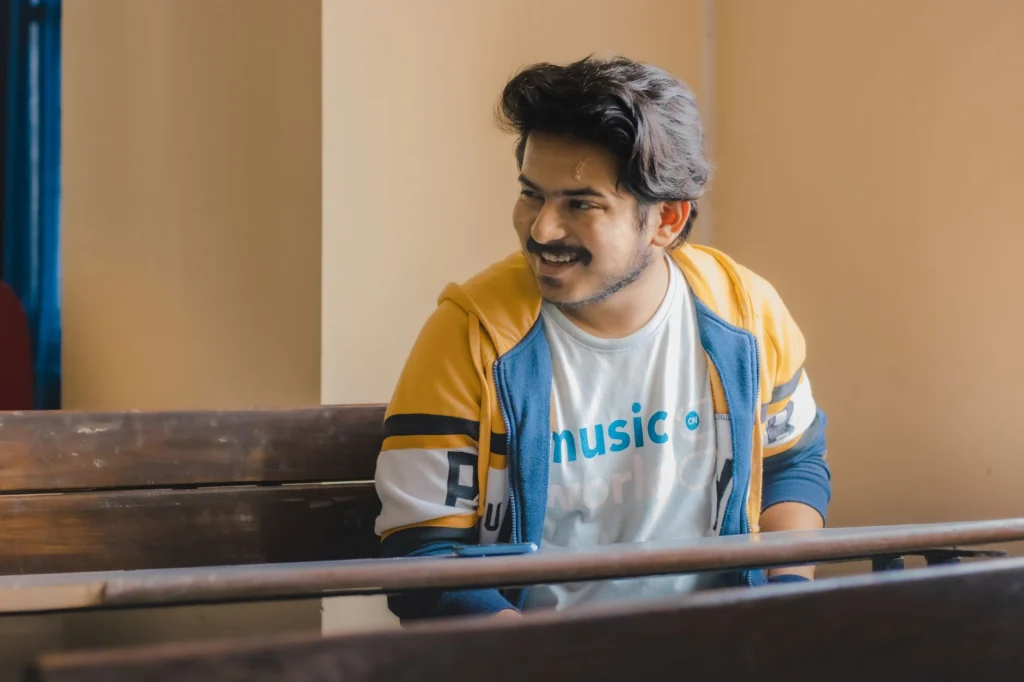
Samay Raina has 8.7 million YouTube subscribers, more than 10 million people following him on Instagram, and — by most journalist-modeled estimates — a net worth somewhere between ₹140 and ₹195 crore. He also spent a stretch of 2025 pulling his own show offline, answering cyber cell summons, and being directed by India’s Supreme Court to raise money for people with a rare disease after a joke on his platform went badly wrong. Both of those facts are part of the same story. Here’s how a Kashmiri Pandit kid who called his own engineering degree “a waste of time” actually became Samay Raina — not the sanitized version, the real one.
Before the Samay Raina Everyone Knows
Raina was born on October 26, 1997, in Jammu, into a conservative Kashmiri Pandit family originally from the Salia area of Seer Hamdan in Anantnag — a region and community whose displacement history is itself well documented, though Raina’s own public material rarely leans on it directly. Around age twelve, his family relocated to Hyderabad, which is where most of his adolescence actually played out. There’s no dramatic origin moment in his childhood that the public record actually supports — no early viral clip, no childhood comedy prodigy narrative. The actual starting point of his career is much less cinematic: an engineering classroom he didn’t want to be in.
The First Moves Nobody Talks About
Raina enrolled in a print engineering course at Vidyarthi Griha’s College of Engineering and Technology in Pune — a genuinely specific, unglamorous technical degree, not a prestigious IIT track people sometimes assume when they hear “engineering student turned comedian.” He’s described the degree itself as a waste of time. What actually filled that time instead was open mics: he started performing on August 27, 2017, while still enrolled, building stage time the unglamorous way rather than skipping straight to an online audience. That distinction matters — Raina’s comedy foundation is a real, in-person, open-mic-circuit apprenticeship, not a platform-native creator career that started with a camera and an algorithm. He opened for established comedians like Anirban Dasgupta and Abhishek Upmanyu in Pune before relocating to Mumbai specifically to pursue stand-up as an actual career, not a side interest.
The First Big Break
The moment that actually changed his trajectory was Comicstaan Season 2 in 2019, where Raina finished as co-winner. That’s a real, verifiable inflection point — a national comedy talent show win is the kind of credential that opens doors an open-mic circuit alone doesn’t, and it’s the first point where “promising young comedian in Pune” became “comedian with a real public profile.” But a Comicstaan win alone doesn’t explain 8.7 million subscribers — plenty of Comicstaan alumni have far smaller platforms today. What happened next is the actual differentiator.
Why It Wasn’t an Overnight Success — The Pandemic Pivot Nobody Planned
When COVID-19 hit and live shows were cancelled entirely, Raina lost the one format his entire career had been built on: performing in front of a room. At fellow comedian Tanmay Bhat’s suggestion, he started streaming chess games on YouTube instead — not as a calculated content strategy, but as something to actually do while stand-up simply wasn’t possible. That’s a crucial, honest detail: the pivot that built the bulk of his current audience wasn’t a brilliant creator-economy insight, it was a forced improvisation during a genuinely difficult stretch for every live performer.
The improvisation worked because of what he did with it. His channel grew to 720,000 subscribers largely through those chess streams, and the real inflection point inside that pivot was guest selection: inviting YouTuber Antonio Radić (Agadmator) onto the channel, then later Indian Grandmaster Vidit Gujrathi, and eventually figures like IM Tania Sachdev, Viswanathan Anand, and even world champion Magnus Carlsen. Raina’s specific skill wasn’t chess expertise — it was making genuinely strong chess players entertaining to watch for an audience that had never cared about the game before, at the exact moment a bored, locked-down country was looking for something new to get into. The chess-streaming boom he became a face of wasn’t something he invented alone, but he was positioned at its center in India specifically because of who he got to sit across from a board.
The Format Innovations That Made Chess Actually Watchable
Getting Magnus Carlsen or Viswanathan Anand to appear on a stream is a booking win, not a content strategy on its own — plenty of channels have hosted a single big-name chess guest without building a real audience around it. What Raina actually did differently was invent formats that made chess funny and chaotic rather than purely instructional: “Hand and Brain,” where one player decides which piece to move and a teammate decides where to move it, and “Dice Chess,” where a literal dice roll determines which piece is allowed to move. He also created “Comedians on Board,” a tournament pitting his comedian friends against each other at chess — regularly pulling in more than 50,000 concurrent viewers, a genuinely large number for what’s ostensibly a board-game stream.
That format experimentation scaled into something more institutional: Chess Super League, an online tournament Raina organized alongside ChessBase India and Nodwin Gaming, structured as six franchise teams of six players each in a 15+10 time-control format, with team owners including fellow creators Tanmay Bhat, Zakir Khan, Biswa Kalyan Rath, Raftaar, and MortaL. That’s a real, franchise-league-style production, not just a livestream — the kind of infrastructure investment that signals Raina treating the chess pivot as a genuine second career pillar rather than a pandemic-era hobby he’d eventually abandon. Multiple serious figures in Indian chess, including Viswanathan Anand, Vidit Gujrathi, and ChessBase India CEO Sagar Shah, have since publicly credited Raina as a meaningful force in growing the game’s popularity in India specifically — a notable form of validation from people with zero comedy-industry incentive to be generous about it.
The Decision That Changed Everything — And Nearly Ended It
In 2024, Raina created and hosted India’s Got Latent, a comedy talent show that became genuinely massive — and also became the single most consequential decision of his career, for reasons that had nothing to do with its popularity. The show’s judge panel included Raina alongside Ranveer Allahbadia (BeerBiceps), Apoorva Makhija (Rebel Kid), and Ashish Chanchlani.
In one episode, Allahbadia made a sexually explicit remark during a “would you rather” segment that went viral for entirely the wrong reasons, triggering national backlash. Raina later revealed, in his 2026 stand-up special, that Allahbadia had actually posed a version of that same question at least eight times across the roughly five-hour recording session — Raina chose to keep only one instance in the final edited upload. That detail matters because it complicates the simple version of the story: this wasn’t a single unscripted slip that got unlucky in the edit, it was a recurring bit that made it through editorial judgment and still detonated.
On February 12, 2025, Raina called off the show entirely and made every episode private on YouTube. That’s about as close to hitting a full stop on a career as a creator can voluntarily do to themselves.
The Controversies and Reality
What followed wasn’t a brief news cycle — it was a genuine, months-long legal and reputational reckoning. Maharashtra’s cyber cell issued multiple summons to Raina over the remarks, with Apoorva Makhija separately having her statement recorded in the same case. In November 2025, the Supreme Court directed Raina and four other comedians involved to raise funds for specially abled individuals, specifically following separately insensitive remarks made about people with Spinal Muscular Atrophy during one of the show’s episodes — a real, court-documented consequence, not a rumor or a fan theory. It’s worth being precise here: these are two related but distinct controversies from the same show — the Allahbadia remark that triggered the initial shutdown, and the SMA-related comments that produced the court-ordered fundraising directive — both real, both consequential, and both worth separating rather than collapsing into one vague “controversy” in the retelling.
Raina’s own response unfolded in stages, not a single clean statement. His first move was pulling the videos and issuing a short statement that his only objective had been to make people laugh, and that he’d cooperate fully with authorities. He then missed multiple official summons over the following weeks before finally appearing at the Maharashtra Cyber Cell’s Navi Mumbai office on March 24, 2025, for an interrogation that reportedly lasted nearly six hours. There, he offered a more direct apology: “I did not intend to say what I said. I apologise for whatever happened during the show and will ensure no recurrence,” explaining that the remarks happened “in the flow of the show” rather than as a planned bit. The professional fallout was real and immediate, not just legal — Raina has said the backlash affected his performance during an ongoing Canada tour, and he rescheduled his India tour dates entirely, offering refunds to ticket holders rather than pushing ahead through the controversy.
What People Get Wrong
The easy assumption is that this was the end of Samay Raina as a public figure — that a creator who voluntarily pulled his own show and faced a Supreme Court directive doesn’t come back from that. That assumption turned out to be wrong, but not because the consequences weren’t real. They were. What actually happened is closer to a genuine reckoning followed by a deliberate, unusually direct public reckoning of his own.
A second, subtler misconception is treating the chess pivot as evidence of some kind of unteachable natural instinct for spotting trends — the “he just knew chess would blow up” version of the story. The actual sequence is closer to the opposite: live comedy became physically impossible, a friend suggested an alternative with zero guarantee of working, and the format only succeeded after real, sustained experimentation (Hand and Brain, Dice Chess, Comedians on Board, eventually a full franchise league) rather than succeeding immediately on instinct alone. The lesson underneath the myth isn’t “he predicted the chess boom” — it’s that a forced pivot, treated as a real second discipline rather than a stopgap, can outgrow the thing it replaced.
The Comeback
Raina returned on April 7, 2026, with his debut stand-up special, Still Alive — a roughly 70-minute set mixing dark comedy with what’s been described as raw, unfiltered honesty about the 2025 fallout, the legal proceedings, and the Allahbadia episode specifically. He didn’t route around the controversy in the special; he built the special around it, directly addressing the backlash rather than pretending it hadn’t happened. Reaction has been mixed but largely positive, with multiple viewers and reviewers specifically noting that his refusal to soften or dilute his usual self-deprecating, brutally honest style — the same style that got him into trouble — was also what made the comeback land rather than feel like a defensive apology tour.
India’s Got Latent itself returned for a second season on June 20, 2026, releasing simultaneously on YouTube and Netflix — a genuinely significant distribution upgrade from the YouTube-only original run, suggesting real institutional confidence in the format’s recovery from a controversy that had, less than a year and a half earlier, taken the show offline entirely.
Where He Actually Stands Today
As of 2026, Raina’s YouTube channel has 8,724,394 subscribers and draws more than 68.7 million monthly views, with Instagram following north of 10 million. Net worth estimates from outlets including the Economic Times, Times Now, and Free Press Journal put his wealth between ₹140 and ₹195 crore — though it’s worth being explicit that these are journalist-built income models based on visible revenue streams, not audited financials, and not a figure Raina himself has confirmed. Separate analysis puts his YouTube-specific annual earnings potentially between $4.1 million and $7.4 million, and he’s become one of India’s highest-paid comedy creators for brand work specifically — commanding roughly ₹70-80 lakh for a single branded Instagram Reel, more than ₹20 lakh for an Instagram Story, and ₹25-35 lakh for a single static post. That rate card alone reflects how thoroughly the post-controversy comeback actually worked commercially, not just critically — advertisers generally don’t pay premium rates to a creator whose audience trust hasn’t genuinely recovered.
His live business has recovered in parallel with the digital side: after rescheduling and refunding his India tour dates during the height of the 2025 fallout, Raina has continued touring internationally alongside the Still Alive special’s release, treating the stand-up special not as a one-off comeback statement but as the anchor of an active, ongoing tour schedule.
Frequently Asked Questions
Did Samay Raina actually study engineering?
Yes — a print engineering course at Vidyarthi Griha’s College of Engineering and Technology in Pune, which he has since described as a waste of time. He began doing stand-up open mics while still enrolled, starting August 27, 2017.
How did Samay Raina become known for chess?
The pivot began as a practical necessity during COVID-19 lockdowns, when live comedy shows were cancelled entirely. At fellow comedian Tanmay Bhat’s suggestion, he began streaming chess on YouTube, and the format grew through inviting strong players (Agadmator, Vidit Gujrathi, eventually Magnus Carlsen and Viswanathan Anand) and inventing chaotic variant formats like Hand and Brain and Dice Chess rather than streaming standard games alone.
What exactly happened with India’s Got Latent?
In February 2025, a sexually explicit remark by fellow judge Ranveer Allahbadia on the show went viral and triggered national backlash. Raina pulled every episode from YouTube and made them private. Separately, the show also faced a Supreme Court directive in November 2025 requiring Raina and four other comedians to raise funds for specially abled individuals following separate remarks about people with Spinal Muscular Atrophy made on the show.
Is India’s Got Latent still running?
Yes — it returned for a second season on June 20, 2026, releasing simultaneously on YouTube and Netflix, a wider distribution footprint than the original YouTube-only run.
How much is Samay Raina actually worth?
Estimates from outlets including the Economic Times and Times Now put his net worth between ₹140 and ₹195 crore as of 2026, though these are journalist-built income models based on visible revenue streams (YouTube earnings, brand deals), not audited financials or a figure Raina has personally confirmed.
So, How Did Samay Raina Become Samay Raina?
Not through one clean plan. An engineering degree he actively disliked pushed him toward open mics instead of away from comedy entirely. A national talent-show win got him a real platform, but not yet a defining one. A global pandemic that should have ended his live-performance career instead handed him an accidental pivot into chess content, which worked specifically because of who he was willing to put in front of his camera, not because he was a chess authority himself. And the single biggest risk of his career — creating and hosting India’s Got Latent — nearly ended everything through a controversy he didn’t personally cause but was still fully accountable for as the show’s creator, before an unusually direct, unsoftened public reckoning brought both him and the show back with real commercial momentum. The version of Samay Raina people know today isn’t the result of a strategy that worked — it’s the result of someone who kept staying in the room, including the uncomfortable ones, long enough for several unplanned pivots to actually compound.