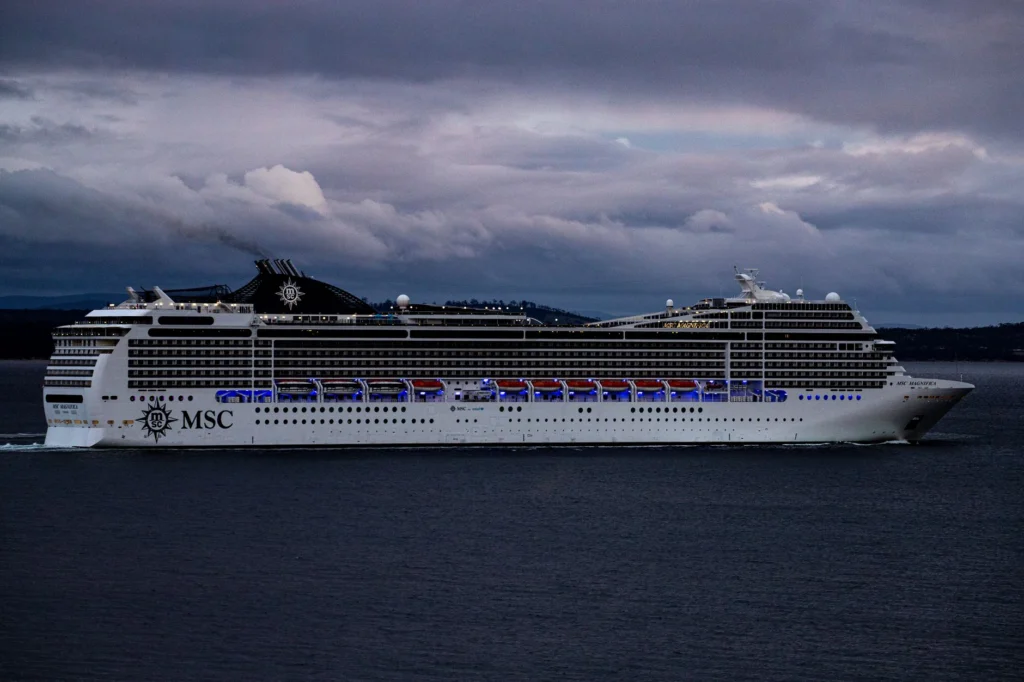
A cruise ship carrying several thousand passengers through open ocean swells staying level enough that most people never notice the sea state at all isn’t a matter of sheer size — it’s the result of an active, mechanical system working continuously beneath the waterline, adjusting itself dozens of times a minute in response to exactly how the ship is being pushed around.
The fins doing the actual work
Modern cruise ships rely primarily on fin stabilizers — retractable, wing-shaped fins mounted below the waterline on either side of the hull, roughly amidships. In calm water they retract flush against the hull to avoid unnecessary drag, but in rough seas they extend outward and continuously adjust their angle, generating hydrodynamic lift forces that actively counter the ship’s rolling motion in real time. This is genuinely active stabilization, not a passive design feature — sensors detect the ship’s roll, and control systems adjust each fin’s pitch automatically, faster than any human operator could react, to push back against the specific roll the ship is experiencing at that instant.
The real limitation almost nobody mentions
Here’s the genuinely counterintuitive part: fin stabilizers depend on water flowing across their surface to generate any force at all, exactly like an airplane wing depends on airflow to generate lift. That means their effectiveness scales directly with the ship’s forward speed — fins are far more effective at cruising speed than at low speed, and they lose most of their stabilizing power when a ship is moving slowly or stopped, which is precisely when passengers might expect the most help. It’s the same physical principle as a wing losing lift at low airspeed, applied underwater instead of in the air.
Ballast: the slower, structural half of the system
Stabilizer fins handle the fast, active correction, but ballast water stored in tanks low in the hull does a different, slower job: lowering the ship’s overall center of gravity and directly affecting the ship’s natural rolling frequency. Placing that weight low and toward the hull’s bottom increases the ship’s inherent resistance to overturning in the first place, meaning the ship starts from a more stable baseline before the fins ever need to actively correct anything. This is a structural, largely fixed contribution rather than a dynamic one — it’s set by how the ship is loaded and ballasted, not adjusted moment to moment the way the fins are.
Hull design does its own quiet share
The characteristically wide hull of a modern cruise ship isn’t purely about interior square footage — a wider beam spreads the ship’s weight over a larger area and lowers its overall center of gravity relative to a narrower hull, which independently improves natural stability before any active system engages at all. Fins, ballast, and hull shape work as three separate layers of the same problem: hull shape sets the baseline, ballast adjusts the starting stability, and the fins handle the fast, real-time correction the other two can’t provide on their own.
The actual takeaway
A stable-feeling cruise ship in rough seas isn’t simply “too big to move” — it’s the product of an active fin system generating real-time hydrodynamic counter-force, working alongside ballast-driven structural stability and hull geometry, with a genuine physical catch: the fins that do the fastest, most responsive work are also the ones that need real forward speed to function at all, which is exactly why the ride can feel different at anchor than while underway through the same rough water.