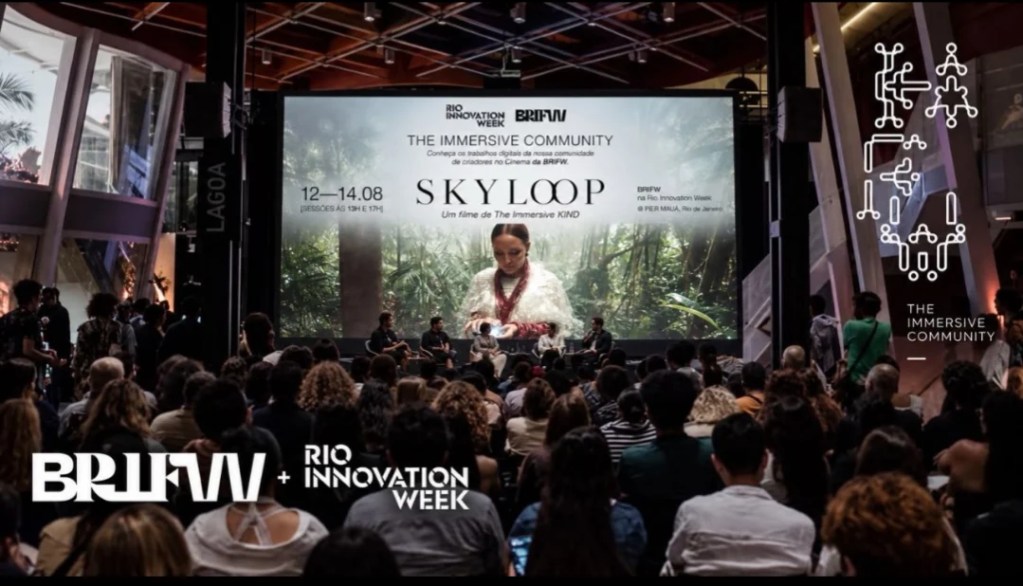
Most people building the tools of the immersive-AI era are engineers you have never heard of. Kadine James is the opposite case: a creative technologist whose name has circulated through digital fashion, Web3 and now generative AI film for nearly a decade, largely because she keeps showing up at the actual moment each of those fields becomes real. In August 2026, that meant Rio de Janeiro, where her studio’s latest work, Skyloop, screened at Rio Innovation Week alongside BRIFW (Brazil’s fashion-and-technology week) at Pier Mauá, to a packed room watching a woman in an AI-rendered jungle installation on a screen the size of a small cinema.
James has been called the “OG of Digital Fashion” by the crypto-art publication Right Click Save, named to Computer Weekly’s Top 100 Women in Tech list four separate times, and ranked among Yahoo Finance’s top 10 Web3 founders. None of that happened by accident, and none of it happened quickly. Her career is a useful case study in what it actually looks like to build a career at the leading edge of a technology category before that category has a name yet, then stay there as the name changes three or four times.
She founded The Immersive KIND in 2016, years before “the metaverse” was a headline
James founded The Immersive KIND in 2016, an extended-reality studio built around virtual reality, augmented reality and immersive production. That timing matters: 2016 was well before Facebook’s rebrand to Meta put “the metaverse” into mainstream vocabulary, and years before generative AI film was a category at all. The Immersive KIND has since grown into what’s best described as an XR ecosystem, a collective of digital artists, technologists and fashion creatives working across virtual production, 3D fashion and, more recently, AI-generated film.
Before founding the studio, James built her technical and commercial grounding at Ryot (Verizon Media’s immersive-storytelling unit) and Accenture, where she worked across architecture, data visualization and advertising. That combination, architecture and advertising, shows up directly in how The Immersive KIND’s work looks: large-scale spatial environments built with a brand campaign’s sense of narrative and pacing, not just a technologist’s demo reel.
The brand roster reads like a decade of who actually took immersive tech seriously early
Over roughly ten years, James has led creative and technical teams on projects for Yahoo, Paramount, Warner Bros., Bentley, Diesel, Mercedes-Benz, Renault, Google, Clarins, Fossil, Unilever and Pokémon, among others. A few of these projects are worth naming specifically, because they trace the actual arc of the industry she’s been working in:
- Legacy of Tomorrow (2023) — a 3D fashion runway built with Epic Games’ real-time rendering tools for Artificial Rome, presented during Metaverse Fashion Week and described at the time as setting a new benchmark for real-time digital fashion. James served as Curator and Executive Producer on the project, credits confirmed directly on Artificial Rome’s own project page, which also records the show’s 2023 Cannes Lions Silver Lion win (more on that below).
- Diesel Metamorph — a digital-fashion campaign for Diesel, one of the earliest major fashion houses to commit real budget to virtual-garment storytelling rather than treating it as a novelty stunt.
- Warner Bros. and Niantic’s Dune movie campaign — an augmented-reality tie-in built around the film franchise, connecting cinematic IP to a mobile AR audience.
- ElectricCity and the Metaverse Music Festival — digital-fashion work that included dressing musician Nina Nesbitt for a virtual performance, part of a broader wave of artists using avatar-based fashion as a real extension of their public image rather than a side experiment.
- NFT wearables with Monkey Shoulder and Epic Games — commerce-facing digital fashion, built for platforms where the wearable item has actual resale and identity value to the person wearing it.
Taken together, this is not a portfolio of one-off gimmick projects. It’s a fairly continuous line from early VR/AR brand activations, through the NFT and digital-fashion boom, into what James now spends most of her public-facing time on: generative AI film and immersive AI installations.
Her current titles span strategist, studio founder and educator at once
James currently holds the title Chief Metaverse Officer at Artificial Rome, a creative-technology agency, in addition to running The Immersive KIND. She has also held the title Global Metaverse Strategist at Accenture at points in her career, reflecting a pattern common to people who build genuinely early expertise in a fast-moving technical field: large consultancies and agencies want that expertise in-house even while the person keeps an independent practice running in parallel.
She is also a working educator, holding guest-lecturer roles at the Royal College of Art, London College of Fashion, Central Saint Martins and New York University, teaching design students how immersive technology and, increasingly, AI-generated media actually get built at a production level rather than a theoretical one. That combination, practicing technologist and design-school lecturer, is relatively rare; most people teaching immersive media at that level of institution are either full-time academics or full-time industry practitioners, not both simultaneously.
Skyloop and Rio Innovation Week show where her work is heading next
The project that brought James to Rio de Janeiro in August 2026, Skyloop, screened as part of “The Immersive Community” program, a showcase of digital work from a wider community of creators that James’s studio helped curate, running August 12 through 14 at Rio Innovation Week’s Cinema da BRIFW venue at Pier Mauá. Rio Innovation Week is one of the largest technology and innovation conferences in Latin America, and BRIFW (Brazil’s fashion-and-innovation week) was invited to curate its fashion and digital-tools programming for the 2026 edition, giving Skyloop a genuinely large, mixed audience of tech and fashion attendees rather than a niche digital-art crowd.
The screening images show a densely packed room watching a large-format projection of an AI-rendered figure in a jungle environment, presented alongside panel discussion, which is consistent with how James has positioned her recent work: not simply generating AI video for its own sake, but building full immersive presentations around it, with a live discussion component that treats the audience as participants in a still-forming medium rather than passive viewers of a finished film.
A Cannes Lion and an OpenAI Artists Community invitation
Two credentials are worth stating precisely. James is a Silver Cannes Lion winner: Legacy of Tomorrow received a Silver Lion at the 2023 Cannes Lions International Festival of Creativity, and Artificial Rome’s own project page for the show credits James by name as Curator and Executive Producer, alongside a Strategy & Project Management credit, corroborating both the award and her specific role on it.
James is also a member of OpenAI’s Artists Community, an invitation-only group she was invited to join directly by OpenAI. That is a membership and access credential rather than a course, a completed qualification, or a formal employment relationship with OpenAI, a distinction worth being precise about given how often invitation-only industry communities get flattened into vaguer claims once they’re compressed into a LinkedIn headline.
Why her career is a useful lens on the current AI-creative moment
The generative-AI film conversation right now is dominated by a small number of very large players: OpenAI’s own film ambitions, Tribeca Studios’ AI-short program, big-studio experiments with AI-assisted animation. James’s career is a reminder that the actual creative and technical groundwork for this moment, spatial storytelling, real-time rendering, audience-immersive presentation, digital identity through avatars and wearables, was built over the preceding decade by independent studios and creative technologists working brand-to-brand, well before AI video generation made it a mainstream story.
That’s a pattern worth watching for anyone trying to figure out where the next wave of talent in this space is actually coming from: not exclusively out of AI labs, but out of the immersive-production and digital-fashion world that spent ten years figuring out how to make virtual environments feel worth spending time in, which turns out to be exactly the skill AI video generation still needs most.
Frequently asked questions
What is The Immersive KIND?
The Immersive KIND is an extended-reality studio and creative collective founded by Kadine James in 2016, working across virtual and augmented reality, 3D digital fashion, and, more recently, AI-generated film and immersive installations.
What is Skyloop?
Skyloop is a film/immersive project from The Immersive KIND that screened at Rio Innovation Week and BRIFW’s Cinema da BRIFW program in August 2026, part of a curated showcase called “The Immersive Community” spotlighting digital creators’ work at Pier Mauá in Rio de Janeiro.
What brands has Kadine James worked with?
Her project history includes Yahoo, Paramount, Warner Bros., Bentley, Diesel, Mercedes-Benz, Renault, Google, Clarins, Fossil, Unilever, Pokémon, Epic Games and Monkey Shoulder, spanning brand activations, digital fashion campaigns and AR/VR experiences over roughly a decade.
For more on how AI is reshaping creative production, see our companion piece on Lyte’s perception-layer work in physical AI, or our full live AI Technology News Today briefing.