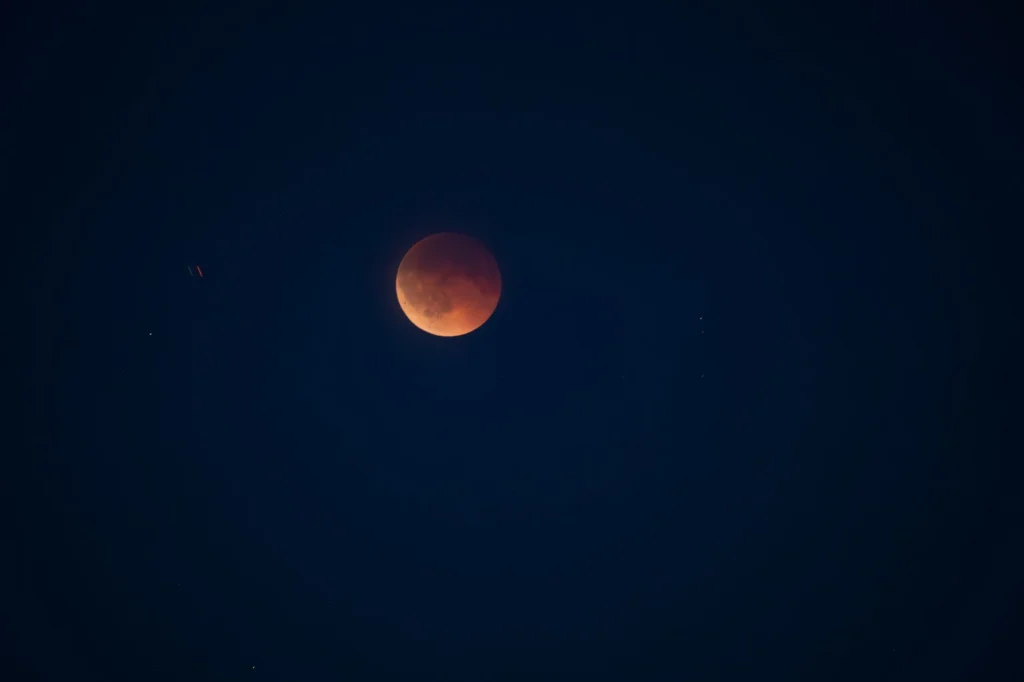
A real, genuinely dramatic lunar eclipse happened overnight on August 27-28, 2026 — and if you missed it, or aren’t sure whether what you saw was actually an eclipse, here’s what actually occurred, backed by the real astronomical data.
What actually happened
This was a partial lunar eclipse — specifically what astronomers call a “deep partial,” meaning it came remarkably close to a full total eclipse without quite crossing that line. At maximum eclipse, roughly 96% of the Moon’s visible disk sat inside Earth’s dark umbral shadow, with the real umbral magnitude measured at 0.9319 — a number that, on a scale where 1.0 would mean the entire Moon is covered, means this event came about as close to total as a partial eclipse can get.
The full event — from the Moon’s first contact with Earth’s shadow to its last — lasted 339 minutes, or roughly five and a half hours, though the visually dramatic part where the Moon appeared to have a real, noticeable bite taken out of it lasted a shorter window around the point of maximum eclipse.
Who actually got to see it
This wasn’t a global event visible everywhere at once — lunar eclipses are only visible from whatever half of Earth faces the Moon during the event, and the timing worked out to favor a specific set of regions. People across Africa, Europe, most of the Americas, and the eastern Pacific Ocean had a real opportunity to see the deep partial eclipse overnight. If you’re in one of those regions and remember checking the sky and noticing the Moon looking unusually dim or partially shadowed, that’s very likely exactly what you saw.
Why a “deep partial” eclipse is worth understanding on its own terms
It’s a real, common misconception that a partial eclipse is just a lesser or less interesting version of a total eclipse. A deep partial eclipse like this one — with 96% coverage — actually produces some of the most visually striking lunar eclipse viewing possible, precisely because it sits right at the edge between the two categories. During a total eclipse, the entire Moon typically takes on a reddish “blood moon” color as it passes fully through Earth’s shadow, with sunlight filtered through Earth’s atmosphere bending around the edges. During a deep partial like this one, viewers instead got a genuinely dramatic contrast: nearly the entire lunar disk shadowed, with a real, visible sliver of brighter, unshadowed Moon still showing at the edge — a distinct visual than either a fully lit Moon or a fully eclipsed one.
The real mechanics behind why eclipses aren’t more common
A lunar eclipse can only happen during a full moon, when Earth sits directly between the Sun and Moon — but full moons happen roughly monthly, while lunar eclipses happen only a few times a year at most. The real reason: the Moon’s orbit is tilted about 5 degrees relative to Earth’s orbit around the Sun, so most full moons pass slightly above or below Earth’s shadow rather than through it. An eclipse only happens on the relatively rare occasions when a full moon lines up closely enough with that orbital intersection point for Earth’s shadow to actually fall on the Moon.
The honest takeaway
If you’re searching to confirm whether you actually saw a lunar eclipse last night, the real answer is yes — a genuine, well-documented deep partial lunar eclipse occurred overnight August 27-28, 2026, visible across Africa, Europe, most of the Americas, and the eastern Pacific, with the Moon 96% covered by Earth’s shadow at its peak. It fell just short of a full total eclipse, but at that level of coverage, it delivered essentially all of the visual drama a total eclipse would have, just without the full “blood moon” red coloring across the entire disk.