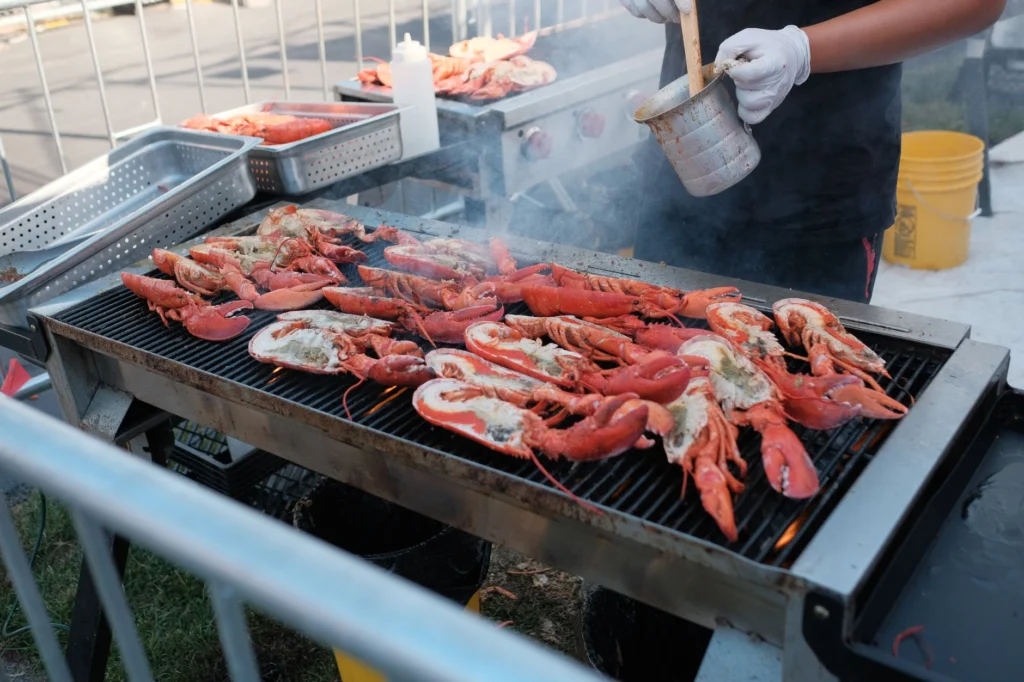
Two months into business, Jim Tselikis and Sabin Lomac had one food truck in Los Angeles and about $150,000 in sales. They walked into Shark Tank in 2012 asking for $55,000 in exchange for 5% of Cousins Maine Lobster.
The pitch did not go smoothly.
The cousins, both originally from Maine, were selling lobster rolls and other seafood from a truck in a city already crowded with mobile food businesses. Their valuation immediately drew skepticism from the Sharks. Kevin O'Leary called their proposal outrageous, while Mark Cuban questioned whether the business had enough of a competitive advantage.
Then Barbara Corcoran made an offer.
She offered the $55,000 they wanted for 17% of the company, eventually settling at 15%. The deal gave Corcoran a minority stake and the cousins the capital and business partner they needed to expand. (pressherald.com)
That small food truck investment became one of the more substantial franchise stories to come out of Shark Tank.
Cousins Maine Lobster started with a Maine connection, not a franchise plan
Tselikis and Lomac were cousins who grew up in Maine and later moved to California. The business idea came from something straightforward: they missed the lobster they knew from home and saw an opportunity to bring Maine-style lobster rolls to Los Angeles.
They launched Cousins Maine Lobster in 2012 with a single food truck. The company says its lobster is sourced from Maine waters, maintaining the connection that was central to the brand from the beginning. (cousinsmainelobster.com)
The early numbers were striking for such a young company. According to reporting around their Shark Tank appearance, the truck had generated roughly $150,000 in sales in its first two months. That was enough to make the business interesting, but not enough to make the valuation easy for the Sharks to accept. (pressherald.com)
The cousins wanted the investment primarily to get another truck on the road.
Instead, they got something more consequential: a partner who understood how to turn a small operation into a scalable business.
Barbara Corcoran paid $55,000 for 15% of the company
The final Shark Tank deal was $55,000 for 15% of Cousins Maine Lobster.
The negotiation took several turns. Robert Herjavec offered $55,000 for 25%, and later proposed $100,000 to help the cousins put more trucks on the road. Corcoran initially offered 17%, while the founders tried to negotiate her down. Eventually, Corcoran agreed to 15%. (pressherald.com)
For the cousins, the difference between 15% and the 5% they originally offered was substantial. But the business was barely two months old. They were not simply selling equity to raise money; they were bringing an experienced operator into a company that was still figuring out what it could become.
That distinction mattered.
Corcoran's role was not limited to providing capital. The founders have described her as a business partner who helped them become more selective about opportunities and approach the company differently as it grew. (inc.com)
Soon after the investment, the company began adding trucks. The founders later described the progression as one truck becoming two and then four, expanding the concept around Southern California before moving into franchising. (thefranchisemall.com)
The real turning point came when Cousins Maine Lobster became a franchise
The Shark Tank deal provided money, publicity and Corcoran's involvement. But the bigger structural change was franchising.
Cousins Maine Lobster began franchising in the mid-2010s, with Entrepreneur listing 2014 as its franchising year. By then, the company was no longer simply trying to operate more company-owned trucks. It was building a system that other entrepreneurs could operate under the Cousins Maine Lobster brand. (entrepreneur.com)
That changed the economics of expansion.
A food truck business can grow by buying another truck, hiring another crew and finding another market. A franchise system can expand through independent operators who put their own capital into individual territories while following the company's operating model.
The company eventually extended that model beyond trucks.
Today, Cousins Maine Lobster offers both food trucks and brick-and-mortar restaurants. Its franchise materials describe restaurant formats ranging from food halls and in-line locations to standalone stores, with buildouts ranging from roughly 200 square feet to more than 1,500 square feet. (cousinsmainelobster.com)
The business therefore evolved from a very specific idea, a Maine lobster truck in Los Angeles, into a broader seafood franchise platform.
Lobster created a problem that hamburgers don't have: the ingredient itself can move dramatically in price
There was an obvious operational problem hiding inside the concept.
Lobster is not a standardized commodity with a stable price. When Cousins Maine Lobster began franchising, the founders encountered significant lobster-price increases. Inc. reported that Tselikis said the price had risen by roughly $3.50 to $5 per pound in the two years after the company's launch. (inc.com)
That matters more for a lobster-focused franchise than it would for a restaurant built around cheaper, more easily substituted ingredients.
The company had to preserve the identity of its signature product while dealing with fluctuations in its primary raw material. Franchisees also needed a business model that could accommodate those changes.
Cousins Maine Lobster's response was not to abandon the core product. It built the brand around the sourcing story itself: Maine lobster, Maine-inspired food and a standardized customer experience.
That identity has remained central to the company. Its current franchise program even sends franchisees to Maine for training, where they learn about lobster harvesting and meet people involved in the fishery. (cousinsmainelobster.com)
The numbers eventually moved far beyond the $150,000 truck
The scale of the business changed dramatically after Shark Tank.
In 2012, the company had one truck. By 2021, Corcoran said Cousins Maine Lobster had reached 35 food trucks and nine restaurants across more than 40 cities in 17 states, with more than $67 million in systemwide sales that year. (linkedin.com)
Those figures are historical rather than current, but they show how quickly the franchise model changed the company's footprint.
By June 2025, Cousins Maine Lobster said it was operating 85 units across 35 states and had surpassed $1 billion in cumulative systemwide sales since its 2012 founding. The company also reported that average 2024 truck sales were approximately $1.3 million per unit, citing Item 19 of its 2025 Franchise Disclosure Document. (prnewswire.com)
The $1 billion figure is systemwide sales, not revenue accruing to the corporate parent or the founders personally. That distinction matters in a franchise business because individual franchise locations are operated by franchisees.
By late 2025, the company said it was approaching 100 units and planned to reach its 100th location in the first half of 2026. (prnewswire.com)
The company's own current franchise materials also show that the model has expanded well beyond the original food truck concept, with both mobile and restaurant formats available. (cousinsmainelobster.com)
Cousins Maine Lobster is now selling a franchise system, not just lobster rolls
The most revealing part of Cousins Maine Lobster's growth is what the company now requires from franchisees.
Its current franchise application calls for at least $250,000 in liquid assets and $500,000 in net worth. The company lists an estimated initial investment of $194,000 to $644,700 for food trucks and $266,700 to $968,900 for restaurants. (cousinsmainelobster.com)
Those figures put the original Shark Tank deal in perspective.
The $55,000 Corcoran invested was enough to help a tiny company take its next step. It would not come close to funding the opening of one of the franchise operations the company sells today.
The company now provides franchisees with training, operational materials, purchasing and distribution support, marketing resources, technology and assistance with site selection or truck construction. (cousinsmainelobster.com)
In other words, the product has become only part of what the company sells.
The larger product is the operating system around that product.
What happened to Cousins Maine Lobster after Shark Tank?
Cousins Maine Lobster did not become a national brand simply because it appeared on Shark Tank. The television exposure helped, and Barbara Corcoran became an active partner, but the lasting transformation came from turning a single successful truck into a repeatable franchise model.
The progression is unusually clear: one Los Angeles truck, a $55,000 investment, additional trucks, franchising, restaurants and eventually a national network.
The company crossed $1 billion in systemwide sales in 2025, according to its own announcement, and its expansion continued into new U.S. markets. (prnewswire.com)
The interesting part of the story is therefore not that two cousins convinced a Shark to buy into a lobster truck.
It is that they took a business whose original advantage was deeply local, Maine lobster served from a Los Angeles food truck, and built a franchise system capable of reproducing that experience hundreds of miles from the Maine coast.
See Cousins Maine Lobster’s full company profile on Talmyn. For other Shark Tank success stories, see Scrub Daddy’s current net worth and the real Bubba’s-Q Boneless Ribs Shark Tank update.
If your company or product is mentioned in this article, you're welcome to share it.