

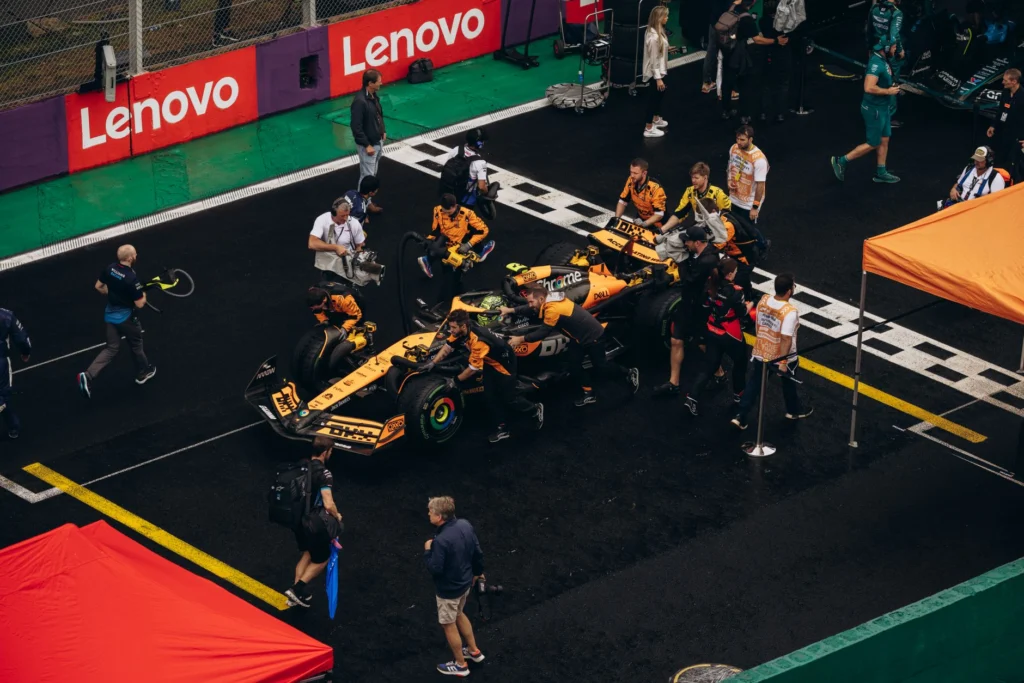
Formula 1 coverage naturally centers on drivers, and the on-track overtakes make for the most exciting footage, but a substantial share of race outcomes over a full season is actually determined by strategic decisions — tire compound choice, pit stop timing, undercut and overcut calls — made collectively by a team’s strategists on the pit wall, often with the driver simply executing a plan decided well before the critical moment arrives.
Tire degradation is the central strategic variable
Modern F1 tires are engineered to degrade at a predictable but variable rate depending on track surface, temperature, and driving style, and teams run extensive simulation modeling before a race to predict the optimal number of pit stops and compound choices for that specific circuit and weather conditions. The core strategic tension is almost always the same trade-off: softer compounds offer more grip and lap time but degrade faster, requiring an earlier pit stop, while harder compounds last longer but sacrifice outright pace — and the team that models this trade-off most accurately for the day’s specific conditions often gains more time than the driver gains through pure racecraft.
The undercut and overcut: strategy as psychological warfare
An “undercut” — pitting a lap or two before a rival, betting that fresh tires’ grip advantage will let the driver complete faster laps and emerge ahead once the rival eventually pits — has become one of the sport’s central strategic tools, and its effectiveness depends heavily on real-time data about tire degradation and traffic that pit wall strategists are constantly recalculating during the race itself, often making split-second calls with incomplete information about what a rival team is planning.
A driver can execute a mistake-free race and still lose position purely because their team’s strategists modeled the tire degradation curve less accurately than a rival’s did.
Why this matters for how fans should watch a race
Understanding the strategic layer changes what’s actually worth watching during the periods of a race that look uneventful on track — the real drama during a long, seemingly static middle stint is very often happening on pit wall headsets and strategy screens, as teams continuously recalculate the optimal pit window based on live tire data, weather radar, and what rival teams appear to be planning, well before any of that translates into a visible move on track.